Showing posts with label Notes. Show all posts

Monday, March 1, 2021

Film Camera

Film camera is also a type of a photographic camera which takes a rapid sequence of photographs on strip of film.

Camera Movements


Pan - Pan is some kind of a horizontal rotational movement in the camera. It only could be a Pan right/Pan left.

Tilt - Tilt is a vertical rotational movement in the camera. it could be a said as Tilt up/Tilt down 

Dolly/Track - The camera is mounted on a cart which travels along tracks for a very smooth movement. It's called as Dolly in/Dolly out. Also known as crab, the cam is mounted on the cart which travels side to side.

Boom - Moving the Camera position vertically with respect to the subject. It's called as Elevate(up)/ Depress(down).

Zoom - Technically this isn't a camera move, but a change in the lens focal length with gives the illusion of moving the camera closer or further away. This is Zoom In/Zoom out.

Focal Length
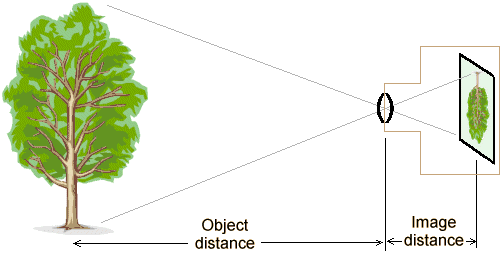


Very simply, it is the distance from the lens to the film, when focused on a subject at infinity. In other words, focal length equals image distance for a far subject. To focus on something closer than infinity, the lens is moved farther away from the film. This is why most lenses get longer when you turn the focusing ring. The distances follow this formula:


Depth of field


Depth of field is the distance between the nearest and farthest object in the scene that appear acceptably sharp in an image.

Perspective Distortion.
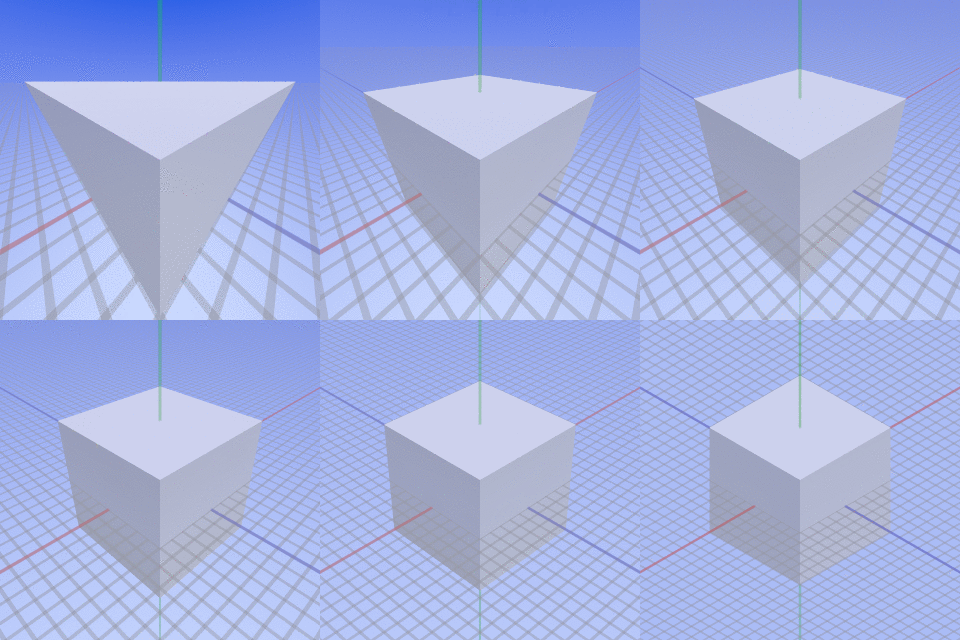

Wide angle distortion - At wide angles, short distances, the object appears distorted.


Narrow angle distortion - At narrow angles, large distances light rays are nearly parallel, resulting a flattened image. 

Friday, February 2, 2018

Grease Pencil

Grease Pencil Logo from Grease Pencil on Vimeo.

Finally, I left Studio 101 after completing all the animations regarding Gajaman, DP & Magodis. The best job & the coolest place to work in Sri Lanka. I'm glad I had all these wonderful opportunities & awesome memories at this little age.

Now I have the confidence to start my own thing. So there we go Grease Pencil... My 1st company founded with my fellow artist together.

We believe in Artistry!

Sunday, May 17, 2015

Quadrupeds Analyse


Before jumping straight into Maya, I thought I just want to get some idea about movements & behavior of the creature that I'm going to animate. therefore i read some books related to these kind of creature animations, example for Eadweard Muybridge's books, Force Animal Drawing, Survival Kit...etc. And I Sketched few poses that useful to get the idea.

Sunday, April 5, 2015

Got the Job (Lead Animator)

Property of Studio 101
This is the Upcoming feature film that I'm working these days, barely started to work on 15 Sept 2014.
Highlight was, this movie is the first 3d animated feature film in Sri Lanka that was used performance capture technology, but you will never notice the technology behind this movie you will be amazed by the story content & comedy that performed by many Major comedic voice artists all over the country (Sri Lanka). Facial animation of this movie was fully functioned by key frame animation method. Film yet to be released in 2017, I'm happy to have an exposure in a film like this working as the Character Lead Animator with among experienced team of good Artists.   

Monday, January 13, 2014

Camera Shot (Staging)

Camera Shot - Action Captured within continuous time or frame.

Don't Cut off heads,knees,necks,wrists in the frame.By only showing half of an already abstracted character,it's harder subconsciously to recognize that character's original shape.

Types of Camera shots.

Extreme long shot

Very long shot
Long shot
Medium long shot

Mid shot

Medium close up
Close up
Big close up

Visual Language

In These days I learning something about Manipulating Time and Space. It's the the main purpose of an Editor in a Film.
After that I heard about Andrea Tharkovsky the great Russian film maker. And some more about his book Sculpting in Time. After Some history lessons i discovered who is the father in the modern cinema the D.W.Griffith.

So step by step learning from those legends activities in history,we can get a little idea about Extended Images & Novelty in Cinema.

Mostly These Type of Storytelling came to Camera after Andrea Tharkovsky discovered this.
Visual Language of a Camera 

Related Topics

Camera angle - Where the  camera is placed in relation to the subject can affect the way the viewer perceives the subject.
Types of camera angle - Eye level angle/Low angle/High angle/Dutch tilt/Point of view/Birds eye/Worms eye

Composition of shot - Organization of pictorial elements in the frame. when you organizing the elements make importance to Simplicity,Rules of Third, Framing and Timing.

Center of Interest - Each picture should have only the principle idea,topic or the Center of Interest to which the viewer's eyes are attracted.

Wednesday, January 8, 2014

Alien Robot Character design

Robot Character
I drew & painted this for just have fun with Watercolors.  

Friday, September 27, 2013

This is what really Overlapping Action is....

Follow Through :- Once a moving figure has come to a halt, certain aspects of the figure(such as arms,hair,tails.etc) or any loose items (such as drapery) may sway forward & backward at a decreasing rate until themselves finally come to rest.

Drag :- Some elements of the figure will begin their motion before others & be the prime source of animation,These parts can be inanimate objects like clothing or the antenna on a car, or parts of the body, such as arms or hair. On the human body, the torso is the core, with arms, legs, head and hair appendices that normally follow the torso's movement. Body parts with much tissue, such as large stomachs and breasts, or the loose skin on a dog, are more prone to independent movement than bonier body parts.

Overlapping Action :- This is where things move in parts, where everything Doesn't happen at the same time. it means tendency for parts of the body to move at different rates (an arm will move on different timing of the head and so on). one part starts first & other part follow.

Saturday, September 21, 2013

No more Confuse in One's & Two's

This is mainly about something in 2D animation

Something that didn't make sense to me when i first heard faster action should be animated on One's. so I thought , "well will not more drawings slow it down."
Then I realize since we're not adding time.the Frames stay the same, same we're just putting more images to connect the action

One's :- one drawing for each frame of film.
Two's :- one drawing held for each two frames of film.

The Rule of thumb :- Use 2's for normal actions 
                                Use 1's for very fast actions
like instance,runs always have to be on 1's & normal action,dialogues on 2's.

Obviously, life is on One's, but Two's work well for most actions and of course it's half as much as doing it on One's and half as expensive.
Working on One's is twice as much work & expense all the way down the production line but result is Tree times better than Two's.
Computer Animators have everything on One's,with perfect inbetweens & it hasn't diminished the appeal of their work rather the reverse. Two's tire the eye after a few minutes.

Twos work - Ones Fly !   

Thursday, June 27, 2013

12 Principles of Animation

These Principles was made buy the Pioneers who we call 9 Old men at Disney. Mostly it came out from the  "Illusion of Life- Disney Animation" book wrote by Ollie Johnston & Frank Thomas in 1981. This is the Bible of animation until today.

1.Squash & Stretch - it is something that gives characters exaggerated weight or a springiness or anticipation to a movement.

2.Anticipation - Prepare the Audience for an action, and make the action appear more realistic.

3.Staging - It's presenting your character's action from the best possible angle. The only view that matter is the camera view.

4.Working Methods (Straight ahead/ Pose to Pose) -Straight ahead animation drawings are made in sequential order (1,2,3,4....etc) It just like we start drawing & see what happen like a kid drawing in the page corners of a school book.
Pose to Pose animation is made by Creating Key Drawings first. and filling the Inbetweens later.

5.Follow through & Overlapping action - One part starts first & other parts follow. Once a moving figure has come to a halt certain aspects of that figure or any loose items may sway forward & backward at a decreasing rate until they themselves finally come  to rest.


6.Ease in/Ease out - Ease In :- This adds some Cushion to the end of the action and gives the object a more natural deceleration and sense of weight.
Ease Out :- This gives a gradual acceleration into the move for natural flow.

7.Arcs - Most actions follow arcs. Generally an action is in an arc. most of the time the path of action of a object is either in Wave like arc or in a sort of Figure 8. But some times it's angular or straight. Remember Straight lines gives Power.

8.Secondary action - Once primary action is completed , the animator may go on to animate the secondary actions that assist the primary actions.(scratching, wiping nose, weight shift...etc.)

9.Timing - It can say as just a series of still images/frames that flash by fast enough to create the illusion of motion. Timing is the beat, Spacing is the change.

10.Exaggeration - Choosing the main idea and sharpen it only where we need to in order as perfect imitation of reality can look static or dull.

11.Solid Drawing - Taking the drawing or the poses into account form in 3d space, giving them volume and weight. What it basically imparts is a dedication to the figure drawing principles that the master animators all added to.

12.Appeal - It could be said that all of the fundamentals combine to make appeal,character design,contrasting poses,contrasting time(rhythm) are all fine tuned. It meant anything that a person likes to see, a quality of charm,pleasing design,communication & magnetism.